
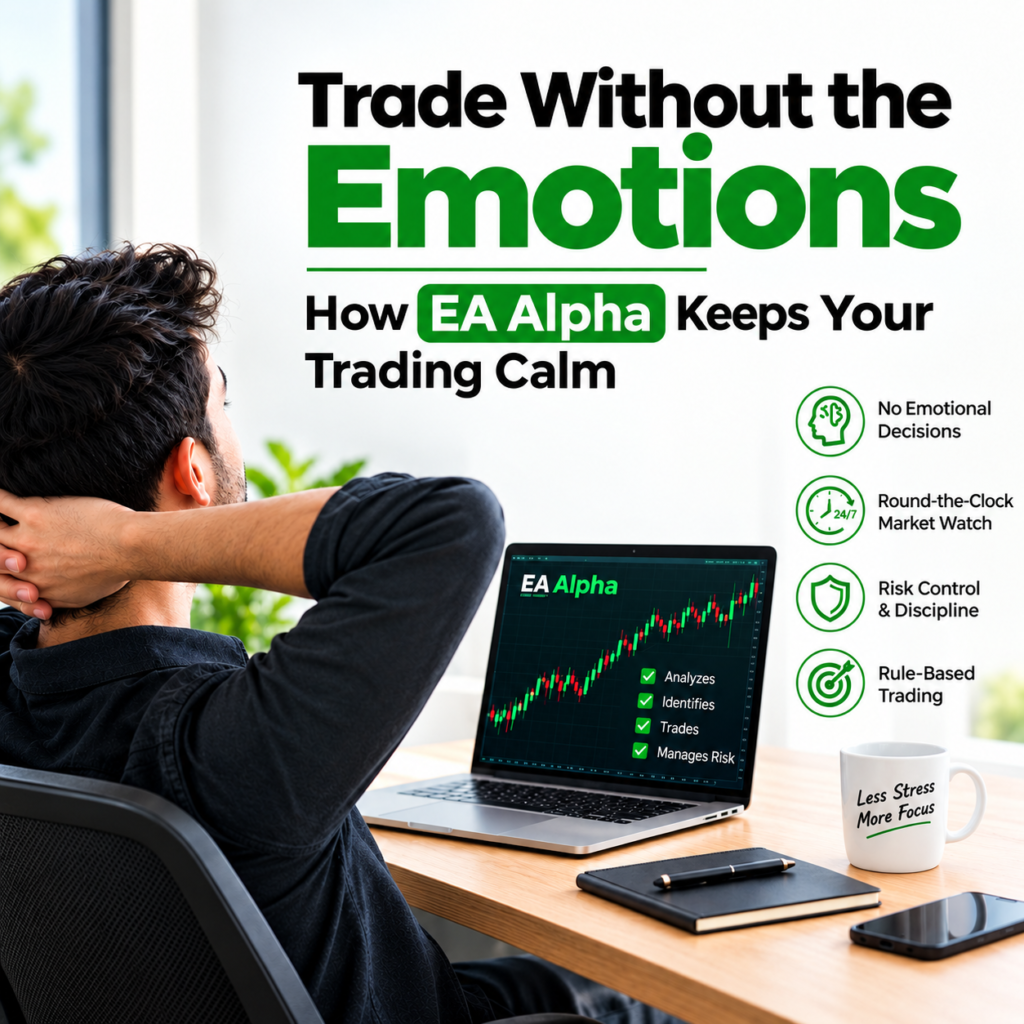
Ask any trader what hurts their account the most, and the answer is rarely “bad analysis.” It’s what happens after the analysis. You plan to exit at a target, then the price gets close and you grab a small profit out of nerves. You promise yourself a stop loss, then move it “just a little” because the trade looks like it’s about to turn.
Nothing is wrong with your chart reading in those moments. Your feelings simply got to the keyboard before your rules did.
The problem nobody puts on a course brochure
Forex education usually teaches patterns, levels and indicators. Far less time goes to the awkward truth that knowing a rule and following it are two separate skills.
Fear makes you cut winners short. Hope makes you sit on losers. After a bad day, the urge to win it all back in one trade shows up uninvited. Anyone who has traded for more than a few weeks knows this loop, and knowing about it doesn’t stop it from happening.
This is the gap EA Alpha was built for.
So what is EA Alpha?
EA Alpha is automated trading software that runs on a MetaTrader platform and places trades for you based on set rules. You stay in charge of the settings. The software handles the part where discipline usually breaks down: pressing the button at the right moment, and sticking to the plan once the trade is live.
It doesn’t predict the market, and it doesn’t claim to. It follows its rules the same way on a calm Tuesday morning as it does during a nervous Friday session. No tiredness, no second-guessing, no revenge trade after a loss.
The loss limit is the real story
Most people ask about profits first. A smarter first question is how much a trade can cost you.
With EA Alpha, you set the loss limit yourself. That number is the most you accept losing on a trade, and the software works inside it. If a trade goes against you, the damage stops where you decided it would stop, before the trade even began.
That changes how a bad trade feels. A loss still stings, but it’s a loss you planned for, not a hole that keeps getting deeper. Accounts rarely die from one controlled loss. They die from uncontrolled ones.
One caution, though. A limit only protects you if it’s realistic. Setting it very wide because the option exists defeats the whole purpose, so choose a number you could take on the chin several times in a row.
What changes when the software takes the trade
You stop staring at the screen. Many beginners trade badly simply because they watch every tick. When the entries and exits follow rules, you can get on with your day, whether that’s a shift, a shop or an evening with family.
Decisions stop depending on your mood. The same setup gets the same response, whether you slept well or not.
Your records get cleaner. Because trades follow consistent rules, it’s much easier to review what worked, what didn’t, and which setting needs adjusting. Messy emotional trades are hard to learn from. Rule-based ones are easy.
What it won’t do
Honesty matters more than a good sales pitch, so here’s the other side.
EA Alpha won’t win every trade or every month, and no software or trader does. It won’t rescue someone who has never learned the basics. It also needs supervision around big news releases, broker problems and unusual market days. Think of it as a very steady assistant, not an autopilot you can ignore.
If anyone promises guaranteed income from any trading robot, treat that as a warning sign.
Seeing the results before you trust it
FTI keeps its own live test results for EA Alpha, so you can look at real performance instead of relying on someone’s word. It’s worth asking to see them, and worth asking questions about drawdown, not just profit. A tool that is open about its numbers deserves more trust than one that hides them behind screenshots.
A sensible way to begin
Start by learning the basics: what a lot size is, how a stop loss works, and why risk per trade matters. Then run EA Alpha on a demo account for a few weeks and watch how it behaves, not only how much it earns.
When you move to a live account, use a small amount, one you could lose without it affecting your life. Keep the loss limit modest, and review your trades once a week. Increase exposure only after you’ve seen steady, sensible behaviour over time.
For traders in West Delhi
If you’re in Janakpuri, Tilak Nagar, Uttam Nagar, Vikaspuri, Dwarka or Paschim Vihar, you don’t have to figure this out alone. The FTI team sits in Janakpuri, and talking to someone face to face often clears up in twenty minutes what takes weeks of videos to half-understand.
Before depositing anywhere, choose a regulated broker and check the current rules that apply to Indian residents. Forex regulations here are strict, so confirm the position with a qualified professional.
Questions traders often ask
Does EA Alpha remove losses completely?
No. Losses are part of trading. What it does is keep each loss inside the limit you set.
Do I need experience to use it?
Basic knowledge helps a lot. You should understand risk and stop losses before automating anything.
Can I change the settings myself?
Yes. The loss limit and other risk settings are in your hands.
Should I test it first?
Always. A demo account shows how it behaves with your broker before real money is involved.
Where can I see the full details?
The EA Alpha page lists the features and how to get started.
Final thought
Good trading is mostly about repeating sensible decisions without letting emotion interfere. EA Alpha doesn’t make you a better analyst overnight, but it takes the most common source of mistakes, your own nerves, out of the moment where mistakes happen.
Visit the FTI office in Janakpuri or read more on the EA Alpha page to see whether it fits your style.
Risk warning: Forex trading carries a high level of risk and may not suit everyone. Test or past results don’t guarantee future performance. Only trade with money you can afford to lose.